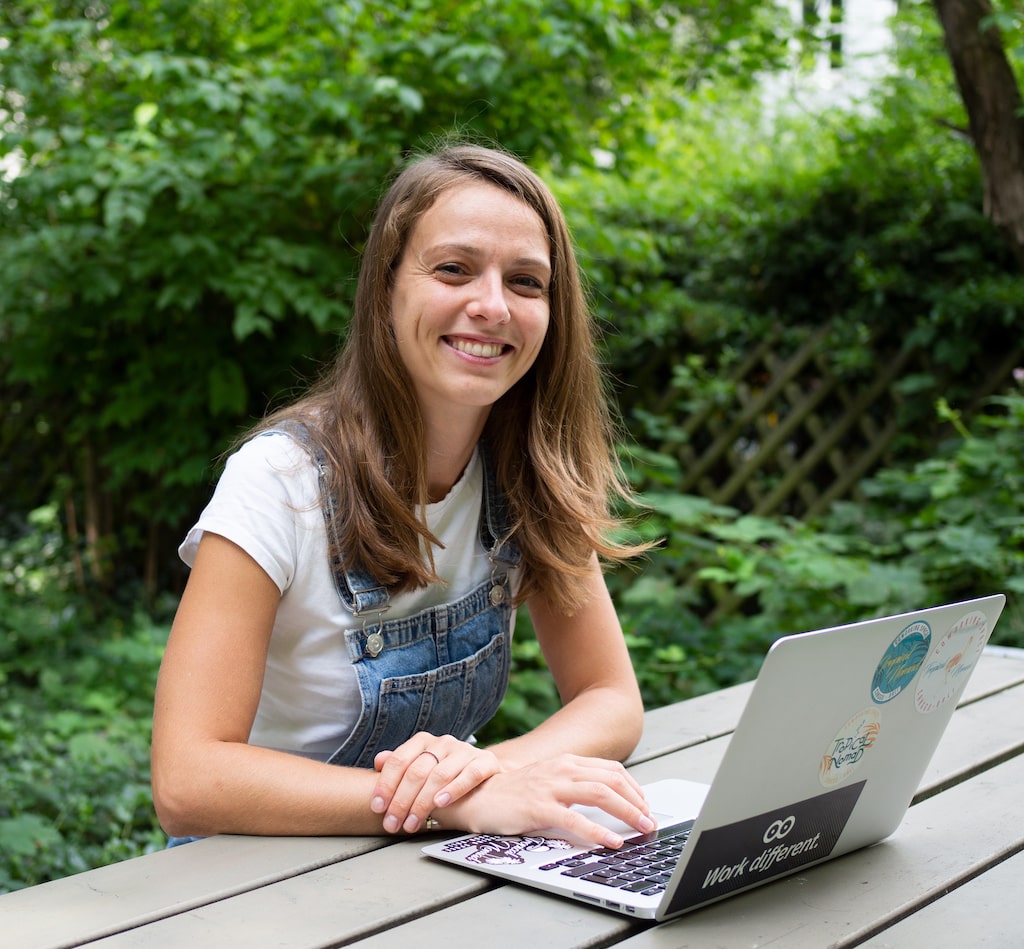
Work from anywhere? Going on trips, realizing one’s dreams, but at the same time not only climbing the career ladder, but also being aware of the security of a permanent job. Remote work describes a way of working and living that many employees find desirable, as it represents a degree of freedom unthinkable in normal office life.
The terms “remote work” and “mobile work,” which differ from the more narrowly defined telework primarily in that employees are not tied to their private sphere, are not omnipresent for nothing. Calls from employees for more creative freedom in their daily working lives are becoming visibly louder. To be able to choose one’s workplace completely freely is a great privilege. But are there also downsides? Josi works as a project and team leader at Kooku and has been living in Bali since November 2018. We asked them about their remote work routine.
Hi Josi, glad you took the time to do this interview! I’m really looking forward to gaining some interesting insights into your remote working life. Please start by telling me a little bit about what you do: What position do you hold at Kooku and what are your responsibilities?
My position at Kooku is project and team lead recruiting. This means that I provide interim recruiting support to clients. I also manage a small team of currently three employees who diligently support in the areas of sourcing, candidate approach, communication and interviewing. My tasks are mainly the coordination of projects, reporting and communication with clients, which in this case are companies that are either looking for employees or need temporary recruiting support due to investments or staff shortages.
How free are you to organize your workdays?
Most of my remote work time so far has been spent in Bali. The time difference between Bali and Germany is between six and seven hours, depending on whether it is summer or winter time. Since I want to be in regular contact with my team and of course have client meetings or interviews with candidates, I try to adjust my working hours to the German working hours. That means I try to keep core working hours between 10:00 and 16:00. I usually start a little earlier and am available from 8:00 am German time, so that means between 2:00 pm and 11:00 pm in Bali. I take my lunch break at the same time as my colleagues in Germany, with the difference that for me it’s more like dinner. Sunset break, as I call it. Between 18:00 and 19:00 o’clock the sun goes down on Bali every day, no matter if summer or winter, and there I usually go to eat and watch the sunset.
That sounds like rather unusual hours for an office job! Can it also happen that you have to work even longer?
Yes. But this is rather the exception. We use various innovative tools such as Microsoft Teams and all applications related to it. This means that our virtual office virtually takes place in Microsoft Teams. Here we can exchange information so that everyone is always up to date. This is very helpful for remote work. Other virtual tools make my day-to-day work even easier. For example, I can set and block my calendar so that I don’t necessarily have to work until 00:00 or longer. But if an important appointment is coming up, there can of course be exceptions. Flexibility is essential.
How were you able to convince your employer to hire you as a one hundred percent remote employee? Are there any special arrangements?
I actually get asked this question more often. For better understanding, before I started working remotely, I was traveling privately in Asia. To do this, I took unpaid leave. If people play with this thought: Unpaid leave can actually be taken by anyone in Germany. At my previous company, for example, there was the option to request a two- to six-month or even one-year unpaid leave. In the process, I fell in love with Asia and then specifically looked for a job that I could pursue from there. That’s actually rather unusual in Germany in permanent positions; you’re looking a bit for a needle in a haystack. I talked to several companies about it, and home offices in Germany or a weekend now and then in other European countries were still something some of them could imagine. But when I told them about my Asia plan, most of them reacted with rejection. Time difference, distance and the prospect that I would always be away for at least three to four months at a time – after all, you don’t fly from Bali to Germany and back every month – put many people off.
I have been in contact with Kooku before. Since I had very positive memories of the company, I immediately applied there during a stay in Germany and openly communicated from the beginning that a life in Bali is my dream. By the way, this is a tip that I would give to all interested parties: If you are looking for a remote job and have to make the necessary arrangements, you should apply from Germany – experience has shown that this process is rather difficult from abroad. I also guaranteed working hours and availability and agreed a trial period in the office with my employer: one to three months on site to get to know the tools, processes and structures, meet the colleagues and build up a little trust. My departure for Bali was on the premise that the trial period would go well for all concerned. I was then allowed to leave after just one month.
Were there any fears associated with your departure for Bali?
Yes, of course I had fears. Since I had only been working at Kooku for a month at that point, I wasn’t yet sure if everything would work out, that is, if the communication would work, if I could deliver good results, if the client projects could actually run completely remotely, and if I could generally do a good job for the company.
Your workplace is the co-working space. What agreements are in place in this regard? Could you theoretically work from your Balinese home?
Yes, I could also work from home. Personally, I rather like to have a work environment and a private environment. In addition, there is always the risk of social isolation when working remotely. That’s why I love working in the co-working space, where I get to work with lots of other interesting people doing all kinds of different things. I asked my employer at the beginning if he would be willing to cover the monthly costs for my space in the co-working space, since he also finances our office in Berlin. In addition, I was provided with remote equipment such as a laptop stand, keyboard and mouse so that I could work reasonably. I could have ordered another monitor, but I haven’t done that yet. As far as I know, employers can also deduct these costs from their taxes.
In your opinion, are there any personal requirements that you need to meet in order to work 100% remotely?
First and foremost, of course, it depends on the type of job. Remote work in general means nothing more than working outside the office. Be it within Germany or another country. I think the challenges are about the same – except for the time difference. You definitely have to be very well organized and structured, manage your days and weeks well, be able to motivate yourself for your job, for your tasks. A good daily structure simply helps. For example, it helps me to arrive at the co-working space at the same time every day and go about my tasks there. I would have problems, I think, working in a home office. A day can become very long. In addition, I think it is important to create compensation, for example through exercise, and a social structure, as is also present in the normal office. If you have to organize, motivate and structure yourself completely on your own, then something like this has even more significance.
That means you need a high level of self-discipline.
Absolutely. Of course, you also can’t let yourself get too distracted – in my case, by the exciting island life in Bali – but you have to clearly define for yourself: “Okay, from Monday to Friday, my focus is on work.” I try to go to the gym regularly during the week, but not much else happens. I live a normal everyday life, like I did in Germany. Also absolutely essential are accessibility and reliability to the team and the employer – even though I am physically absent, I am present and ensure that projects progress according to plan. In the end, of course, the results are decisive. The better the results, the more freedom you have, of course.
Have you ever had the feeling that you are under more pressure to justify yourself than your colleagues who work in the field?
In the beginning, yes. Of course, a certain basic trust must first be established and, last but not least, as I said, the work results count. If the work results are right, I have a lot of scope for decision-making and action. If isolated problems arise, certain things have to be justified sooner.
Do you feel sufficiently integrated into your team? Or do you sometimes feel like you’re a little out of the loop and missing out?
No, I actually hadn’t until then. We exchange ideas several times a day, have team meetings, work together on projects. We also had other remote employees in the team: France, Spain, Cologne. Many colleagues are in Berlin, but there were and are always some who are not there for a short or longer period of time. This makes you not an outsider.
Earlier you already discussed some important tools. How exactly do you keep in touch with your colleagues?
That’s right, we have Microsoft Teams. It’s kind of our virtual office where we maintain different channels for different clients and projects. This is where we communicate and ensure information transparency. We also use other Microsoft tools, such as OneNote, Planner and To-Do, to organize our projects and ensure a high quality of our project management. Of course, you can also make video calls and meetings over it. It all works very well! We no longer use paper documents.
That sounds like a lot of documentation in exchange for such a level of freedom.
Exactly. For example, we also work with a time recording tool: Since we work for customers on an hourly basis, it is necessary that we reliably record our hours worked. In addition, we document exactly what we have done – after all, the customer has a legitimate interest in knowing what happens to his money. Time recording is therefore not only mandatory for remote work, but for the entire team.
Earlier you mentioned that you are responsible for a team. Do you have tips for digital leadership? Are there problems and obstacles?
In my opinion, communication is absolutely necessary! Not getting “lost” on the other side of the world, but staying in touch. Our bi-weekly feedback talks always take place. Even if you sometimes think there is nothing to talk about, important topics always come to light in the course of the conversation. Since I’m not involved in every project myself, I often solicit feedback from others with whom the members of my team work. But I firmly believe that regular, open communication is the most important thing: ensuring accessibility. Check with the team to determine when who is available. Problems and obstacles caused by not being on site? I have not been able to detect any so far. I think that it depends not least on the people involved, the type of communication and the general mood in the company. I don’t feel as much that the nature of collaboration is affected by whether you work on-site or remotely.
Are there moments when you wish you could be in the office?
Yes, sometimes. However, in compensation for being so far away, I make sure to make my way to Germany at not too long intervals so that I can be in our Berlin office. About every five to six months I can be found there for a longer period of time. The longing is not too great in between.
What do you think are the weaknesses of remote work?
The weaknesses? Well, I would rather call it challenges! Challenges are definitely the social issues: not sinking behind your own laptop and sliding into social isolation, but staying in touch with others. I try not to let comfort set in in this regard, but to always remain active. I think that is very important. Because we are very well positioned digitally and can structure ourselves very well with our tools, I don’t see any further major challenges.
Could you imagine entire teams working remotely in the future, i.e. contact taking place only virtually and there being no office at all? Would something like this be feasible? And if so, what would it take to make that happen?
Yes, I can definitely imagine that! In the USA, for example, there are already companies that do not have an office and have never had one. I am convinced that the right tools and communication rules make this possible. I think it’s important to organize a team event at least once a year where everyone can get together. Introducing yourself personally to the customer before working together also makes a big difference – you simply get to know each other on a different level. Otherwise, in my opinion, it all depends on the business model. Can I offer my service remotely or are there gaps? I think that’s a bigger challenge than actually working together as a team.
Finally, I would like to know what happens next for you. Will you stay in Bali, seek new adventure again or maybe even return to Germany for the long term?
Due to the Corona crisis, I am currently back in Germany for the time being. Next, I would like to go to Portugal. There the landscape is similarly beautiful as on Bali: cliffs, surfing, beaches. The advantage is that Portugal is a little closer to home, so the time difference is naturally much smaller and the working hours fit better with those in Germany. That would be my next goal for late summer. Let’s see how I like it there.
Super. Thank you very much for the interview!